SISU Military Truck Part I

4x4 Sisu SA-150 ,
DATA
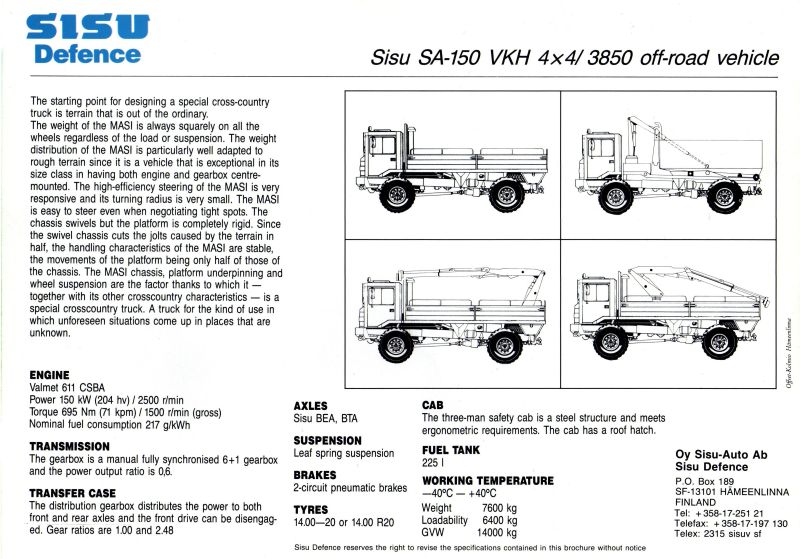
The SISU SA-150 general utility truck is also referred as the "Masi". Its development began in 1978. The first prototype was completed in 1980
SISU SK 4x4
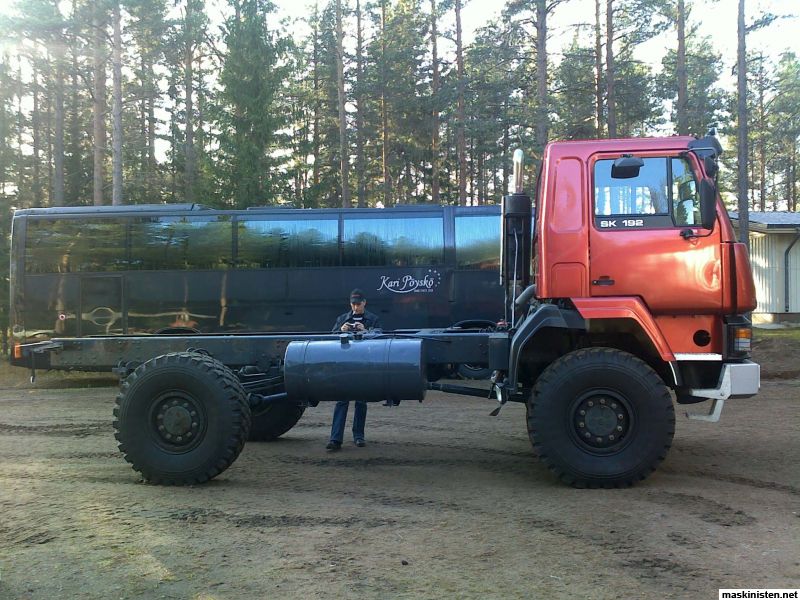
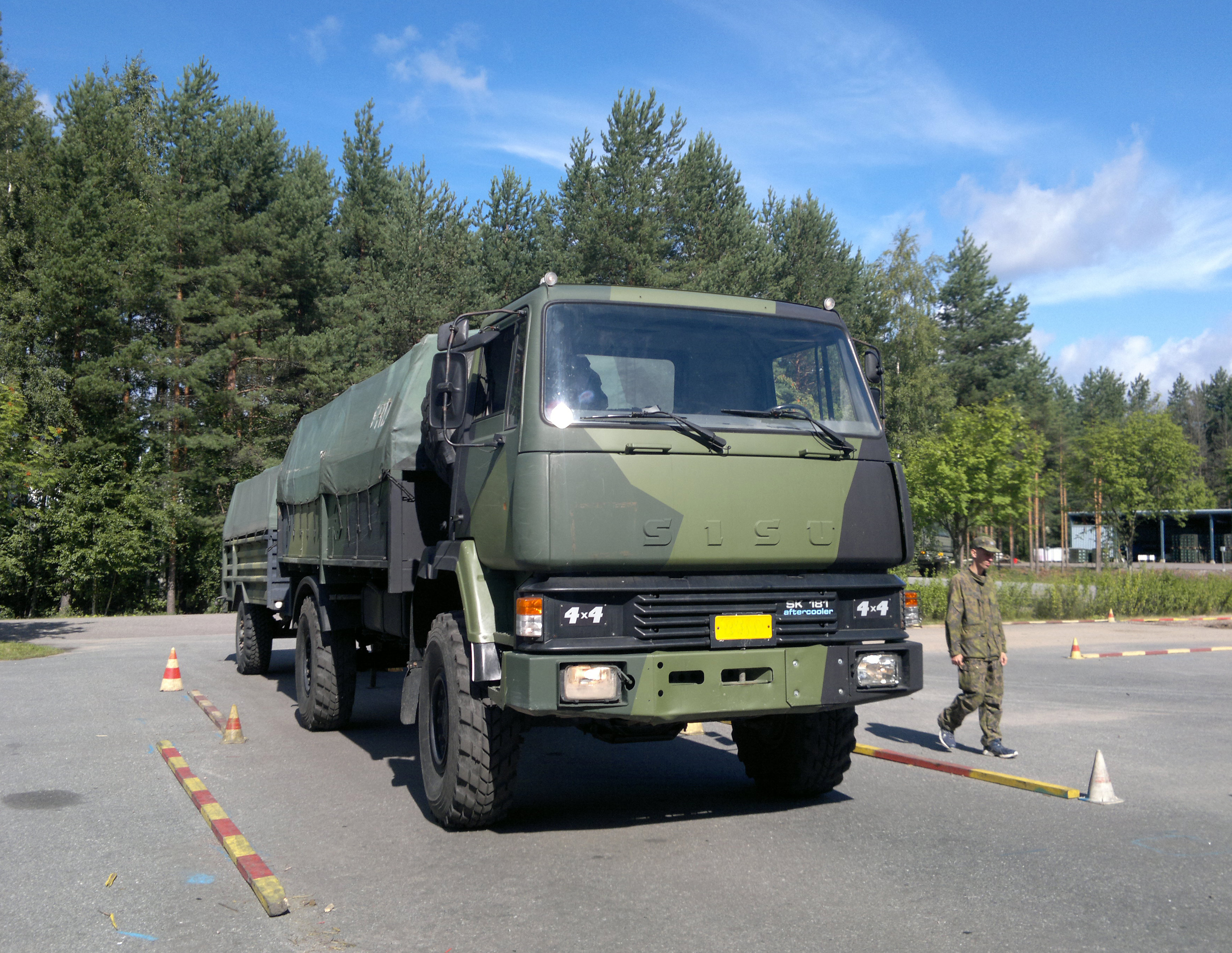
SK171 - 1986, SK181 - 1990, SK-192
SISU A2045
The Sisu A2045 HMTV (High Mobility Terrain Vehicle) is a Finnish standard medium tactical truck, intended to replace older SISU A45 "Proto" light trucks in the Finnish Defence Forces.
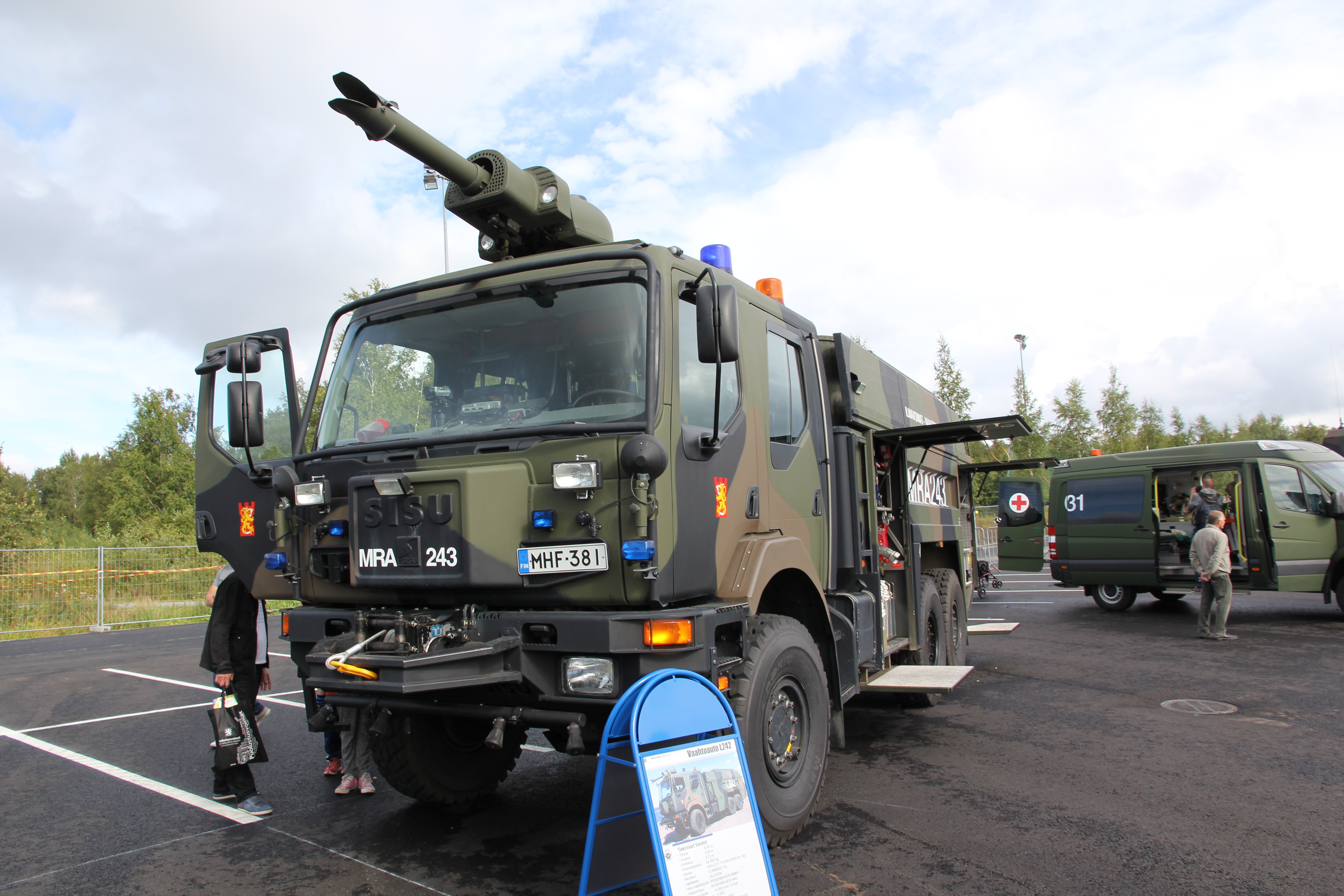
6x6 The Sisu SA-240 heavy utility truck is also referred as the Rasi. Development of this military vehicle began in the 1980s. The SA-240 is a larger and heavier version of the SA-150, with a 6x6 drive configuration and improved payload capacity. Production commenced in 1984 and ceased in 1990. Currently it is in service with the Finnish Army. SISU SK 250 CHK 6x6 The Sisu E11T is a high mobility tactical vehicle, designed for northern conditions. Sometimes it is referred as the Sisu HMTV. It was developed in cooperation with Finnish Defense Forces and is intended for a wide variety of applications. The first example was revealed in 1998. Transfer Case - Steyr, Cab - Renault Premium
Base For HTMTV-ARFF
Sisu K-44 Sisu K-44 is a three-axle 4x4+2 driven lorry made by the Finnish heavy vehicle manufacturer Suomen Autoteollisuus (SAT) from 1959 to 1965.
Tandem axle of Sisu K-44.The foremost axle on the tandem axle is powered. When fully loaded, the K-44 carries approximately 62% of the weight lying on the tandem axle. The rear, non-driven axle, is linked to the driven axle through a simple sub-assembly consisting of 3.5 in (88.9 mm) wide and 1,500 mm (59.1 in) long leaf springs and rocker arms. When the torque delivered to the rear axle is increased, the mechanism automatically shifts vehicle weight away from the non-driven axle to the driven axle, improving traction when most needed. Additionally, more of the weight can be moved to the driven axle manually using an electro hydraulic system. In order to reduce fuel consumption and tyre wear the non-driven rear axle can also be raised completely off the road/surface, if a third load-bearing axle is not needed because the vehicle is running empty: running on just two axles also reduces the K-44's turning circle.
The wheel size is 7.5–20" and each wheel is held in place with ten nuts. Both axles on the bogie are fitted with double wheels as standard other than on the K-44ST, which made do with single wheels on the non-driven rearmost axle.
On the early K-44s the tandem's driven axles are identical on the middle-weight "Kontio" and the heavy-weight "Jyry" versions. The axle, designated "Type ATK" was designed by SAT and was based on the manufacturer's "Type ATD" axle originally introduced for earlier models n the early 1950s. The "Type ATK" proved durable in the Kontios, but was unable to cope with the greater power and load of the Jyry trucks, and in the early 1960s SAT developed a more robust driven axle, known as the axle "Type BTK", for the heavier variants.
The axle housing is a welded construction made from formed steel. The transaxle used hypoid gears.
The K-44 features a driven double reduction front axle incorporating an interlockable differential.The steering knuckles are attached via bevel roller bearings, while the front drive shaft uses homokinetic joints. The wheel hubs incorporates planetary gears, which permits a higher ground clearance through the inclusion of a small differential unit.
Sisu KB-45 is a light off-road lorry made by the Finnish heavy vehicle producer Suomen Autoteollisuus (SAT) in 1965–1970. The two-axle, all-wheel-drive vehicle with payload of 4 000 kg was developed after an assignment of the Finnish Defence Forces. It was followed by almost similar A-45/AH-45 in 1970.
The project coordinator was Senior Engineer Uoti Hartikainen.
The first prototype was built by SAT Testing Department in Fleming Street, Helsinki in March 1964.
The axles were made by Kirkstall axles .
The vehicle was nicknamed at an early stage Proto, which was derived from prototyyppi (prototype).
The successor of KB-45, A-45/AH-45, was very similar. The biggest difference was in transmission as the Kirkstall axles axles were substituted by Sisu's own products. At the same time the production was moved from Karis to Hameenlinna, the former Vanaja factory which was merged with SAT in beginning of 1969.
Sisu A-45 is a light off-road lorry made by the Finnish heavy vehicle producer Suomen Autoteollisuus (SAT) in 1970–1982. The two-axle, all-wheel-drive vehicle with payload of 4 150 kg was a further development of Sisu KB-45, that was originally developed after an assignment of the Finnish Defence Forces.
A-45 based technically on its predecessor KB-45. The most significant difference was that the Kirkstall axles were substituted by Sisu's own axles.
The predecessor KB-45 was produced in SAT Karis works. In 1969 SAT merged with Vanajan and when A-45 was presented in 1970 the production of Sisu military vehicles was moved to the former Vanajan works in Hameenlinna. However, some of the A-45's were made in Karis due to occasional lack of production capacity in Hameenlinna.
Just like KB-45, A-45 is informally called Proto. The name is derived from the Finnish word prototyyppi (prototype).
The "Proto's" are substituted in Finnish army by 2008 presented Sisu A2045 lorries.
The main gearbox contains five speed forward of which all are synchronised and one reverse gear. In addition, the vehicle is equipped with a two-step reduction gear. Both axles are driven and equipped with planetary hub reduction and differential locks.
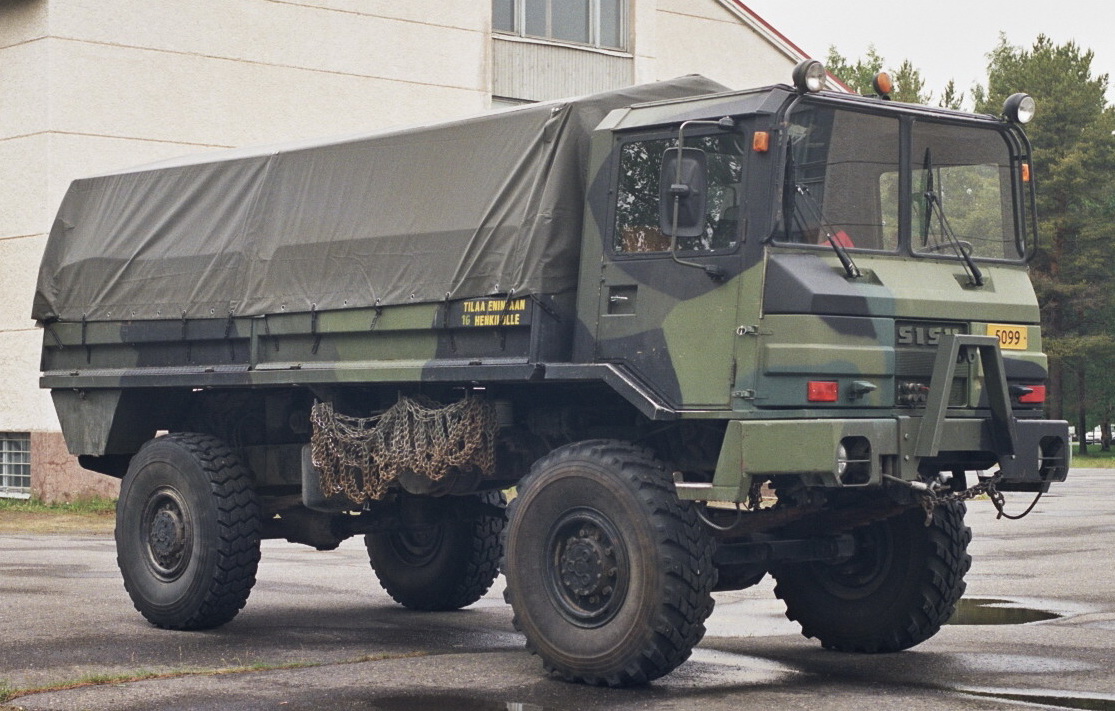
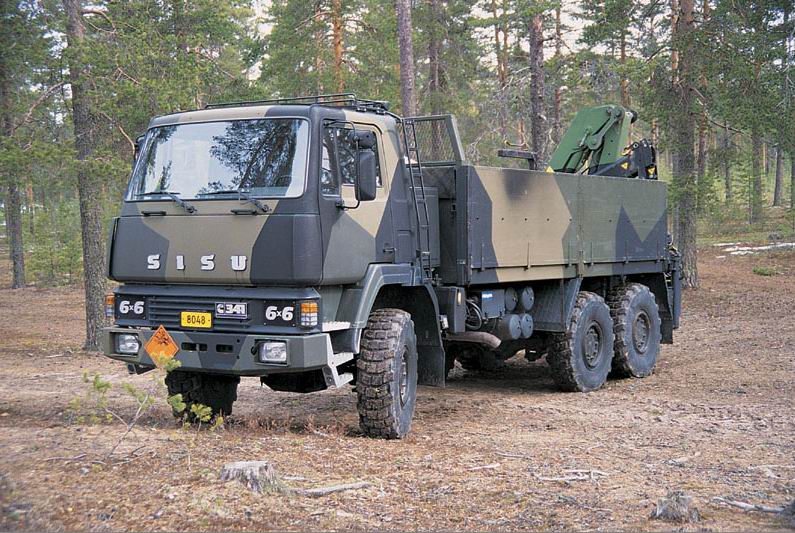
Sisu SA-150 is a medium-size, two-axle off-road lorry made by the Finnish heavy vehicle manufacturer Oy Sisu-Auto Ab from 1982 until 1991. The four-wheel-drive lorry with load capacity of 6 400 kg was developed for pulling of heavy cannons of the Finnish Defence Forces.
Based on experience from Sisu A-45 and due to new, heavier cannons, there came a need for stronger vehicles in the Finnish Defence Forces. Due to this, Sisu-Auto started a development project of an entirely new medium size off-road lorry.
The engineering work began in 1978 in the main office of Sisu-Auto located then in Fleming Street, Helsinki. The project manager was Seppo Kokkola, the head engineer of the company. The other members were Kari Lindholm, Veli Vallinoja, Uoti Hartikainen and Kalevi Kakko who were the most notable engineers of Sisu-Auto. The starting point was NATO compatibility, which can be seen for instance on the tyre size of 14.00-20 and the general looks of the vehicle. Building of the first prototype was started in November 1979 and the first test run was performed in the following February. In April the prototype was taken to Rovajarvi for field testing and in the following autumn began a half-year testing programme. The vehicle passed the tests of the Defence Forces.
The prototype was called SA-140.
At its early development A-45 had been nicknamed "Proto-Sisu", referring to prototype, by the Finnish army officers. Obviously, Sisu-Auto did not like this name and named the vehicle Masi, which comes from Maasto-Sisu, "Terrain Sisu" Masi is also the Finnish name for Beetle Bailey.
The Sisu SA-150 has a twisting chassis and a well balanced load distribution, that allows excellent cross-country mobility. These features ensure, that all four wheels are in contact with the ground at all times
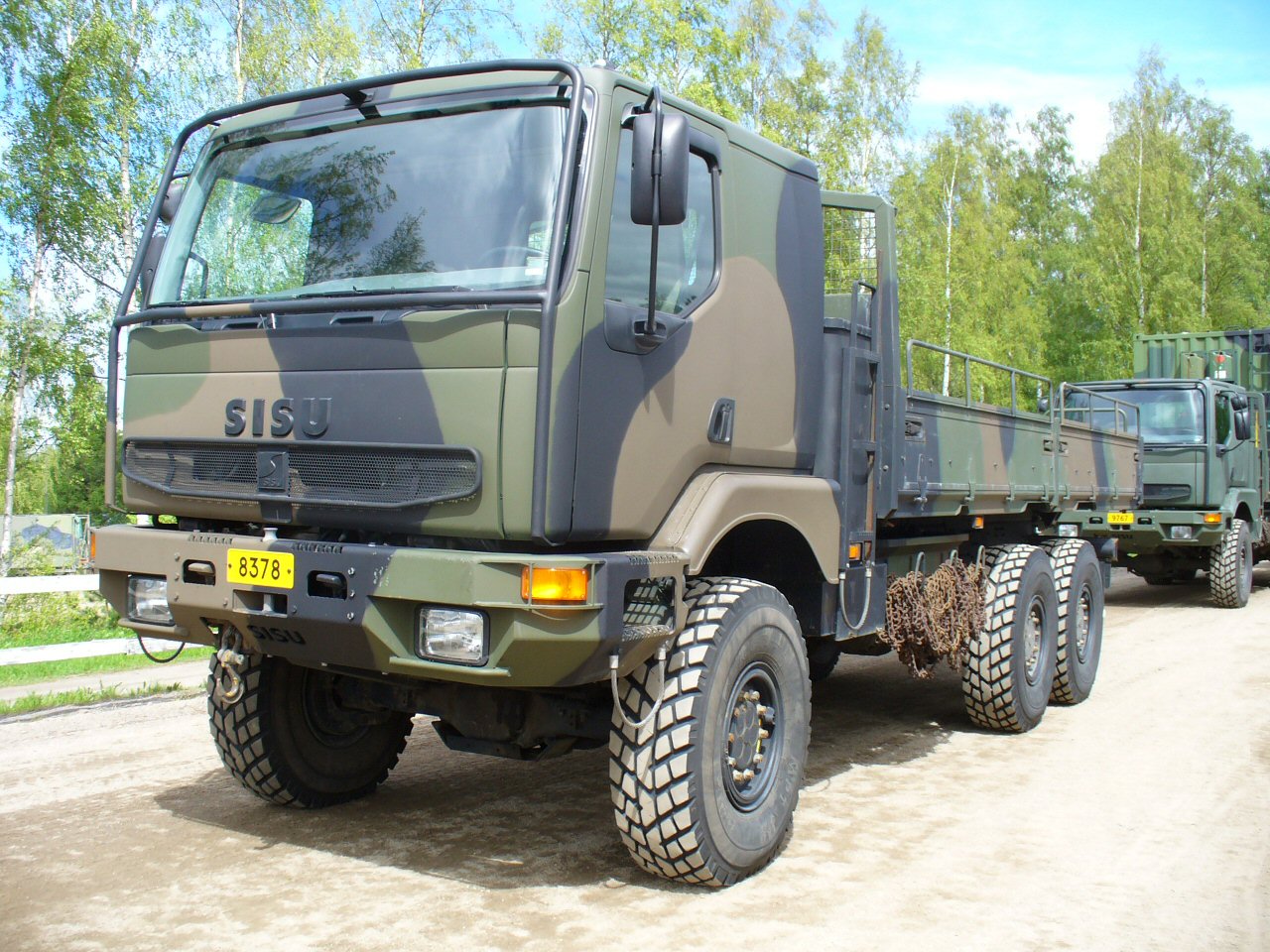
The Sisu A2045 HMTV (High Mobility Terrain Vehicle) is a Finnish standard medium tactical truck, intended to replace older SISU A45 "Proto" light trucks in the Finnish Defence Forces. In spoken language Sisu A2045 is called the MAN-Sisu referring to the engine, axles and other elementary parts delivered by the German lorry manufacturer MAN Nutzfahzeuge, officially MAN SE, former MAN AG. For the personal transportation on the installed seats, twelve persons can travel outside the driver's cabin. The lorry is classified by its weight as a middle off-road logistic vehicle.
The trucks are used for general logistics and conscript training, as well as for towing artillery pieces, anti-aircraft weapons and command modules.
Sisu A2045 is the successor of Sisu A-45, Sisu AH-45 and Sisu KB-45. The A2540 was introduced at the Security and Defence 2008 exhibition in Lahti, Finland.
Finally, after decades of planning, the defence presented Sisu SISU A2054 HMTV brand new 4 x 4 offroad truck security and defence fair in September 2008 year.
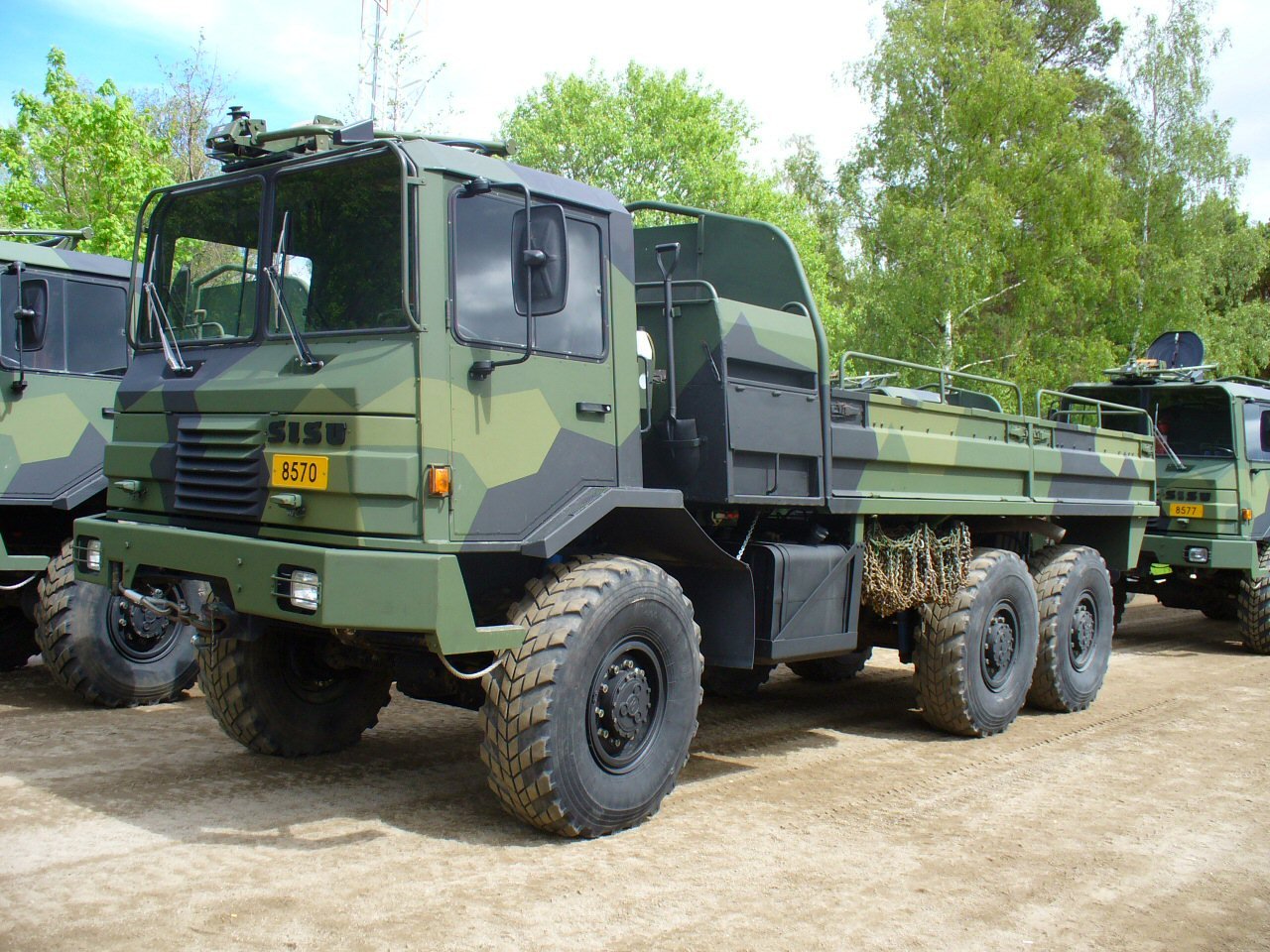
Sisu SA-240 is a heavy off-road lorry made by the Finnish heavy vehicle manufacturer Oy Sisu-Auto Ab from 1984 until 1991. The six-wheel drive lorry with payload of 12 000 kg was developed for pulling of heavy cannons of the Finnish Defence Forces.
The Sisu SA-150 medium size off-road lorry turned out to be too weak to pull the heaviest, domestic made cannons of the Finnish Defence Forces. A new 6?6 lorry was suggested as a solution. The development work began in 1983. The first two prototypes, called SA-180, were powered by turbocharged Valmet 611 engines with a maximum output of 180 kW. The transmission, made by ZF, was equipped with a torque converter which enabled flexible driving on road and terrain. The system was tested by driving a test vehicle from Hameenlinna to Sodankyla with the same gear.
After field tests were completed the engines were replaced by 10-litre Cummins diesels and the model code was changed to SA-240. The vehicle was soon nicknamed Rasi, which came from Raskas Masi, "heavy Masi".
The first factory produced SA-240, configuration Sisu SA240 CKH-6x6/4950+1440, was handed over to the Finnish Defence Forces in May 1984. The vehicle was built with an extra long wheelbase and equipped with a detachable anti-ship missile system MtO 85. The first SA-240 made for artillery use, configuration Sisu SA 240 CKH-6x6/3740+1440, was handed over at the end of the following year. In 1987 a series of 13 vehicles was produced and serial production began in 1988. SA-240 was replaced by further developed SA-241 in 1990, but the production ceased already in 1991.
The ZF 8F1R transmission is equipped with an integrated torque converter. All the three axles are driven. The wheelbase between the rear axles used to be the longest in market to enable use of snow chains. The chassis is twisting type.
Sisu E11T 8x8 The Sisu E11T 8x8 high mobility tactical vehicle is based on the E11T 6x6. It is also referred as the HMTV. This military truck was specially designed in cooperation with Finnish Defense Forces for operation in northern conditions. This heavy utility truck is produced in Finland since 2001. The Finnish Defense Forces operate over 40 of these vehicles, fitted with integrated Multilift load handling equipment. This military truck is also proposed for export operators.
Sisu E13TP 8x8 Sisu E13TP is a military terrain lorry produced by the Finnish heavy vehicle producer Sisu Defence. The vehicle was introduced in 2005 and the first vehicles were delivered in 2007. E13TP is available in layouts 6x6 and 8x8. The stronger variant E15TP is with 10x10 layout. The primary military applications are hook loader, radar carrier, missile launcher, recovery vehicle and bridging vehicle. Some civil applications are produced for oil fields and rescue purposes in particular.
Military Vehicles Sisu Axles is owned by Marmon Highway Technologies (MHT), a Berkshire Hathaway company, serves the global heavy-duty transportation industry, with a broad range of innovative components and assemblies.
Sisu_Axles is a producer of heavy vehicle axles in Hameenlinna, Finland.
Marmon-Herrington Heavy-Duty Axles
Sisu-axles manuals
Sisu-axles
Vanajan Autotehdas
Vanajan Autotehdas Oy (VAT) was a producer of heavy vehicles based in Hameenlinna, Finland. The company was founded as Yhteissisu Oy in 1943 by the Finnish government and a number of major Finnish companies with the aim of producing lorries and buses for the Finnish Defence Forces. World War II was over before the company could start series production; it was renamed Vanajan Autotehdas and the marque became Vanaja. Subsequently, the production consisted of outdated lorry models, partly built from military surplus materials. After overcoming initial difficulties, the company modernised its products, became profitable and grew until the mid 1950s. Many major components, including engines, were imported. Diesel engines became widely available in 1955, and in 1959 VAT introduced its most significant innovation, the full load lifting tandem axle mechanism, which improved off-road capability significantly; the system is now used in Sisu vehicles.
The company started producing bus chassis in 1950, and the superstructures were built by a number of Finnish coach builders. The last models were appreciated by a number of bus operators, and missed after production was stopped. All Vanaja bus chassis were fitted with air brakes by 1958, after the failure of hydraulic brakes on a Vanaja bus had led to one of the worst traffic accidents ever to have happened in Finland.
VAT fell into financial difficulties by end of the 1960s; this led to a merger with the other Finnish heavy vehicle producer Oy Suomen Autoteollisuus Ab at the end of 1968. The Vanaja brand ceased to exist in 1971, after which the former Vanaja factory produced Sisu terminal tractors, bus chassis, military vehicles and mobile crane chassis. The factory now belongs to Patria—which produces Patria AMV armoured personnel carriers—and heavy-vehicle axle producer Sisu Axles.
Vanajan Autotehdas was always a small company, employing about 400 people in 1968, and in the 1960s its market share was barely 5% in Finland. Almost all Vanajas were sold for the domestic market; only a few units were exported. Vanaja vehicles became known for their robust construction and high degree of customisation. The number of Vanaja bus chassis and lorries totalled 7,140 units; this consists of 260 lorry and 66 bus chassis models; for 116 lorry models only one or two units were produced. Vanajas had a good reputation and they are nowadays valued by vintage vehicle enthusiasts.
Next ... SISU Military Truck II .
Âíåäîðîæíûå òðàíñïîðòíûå ñðåäñòâà (Land Locomotion – Mechanical Vehicle Mobility LL-MVM) Home